How frequently do you consider giving up your work? How often do you think you are underpaid for the commitment and service you provide to your company? How frequently do you feel unhappy or dissatisfied with your job?
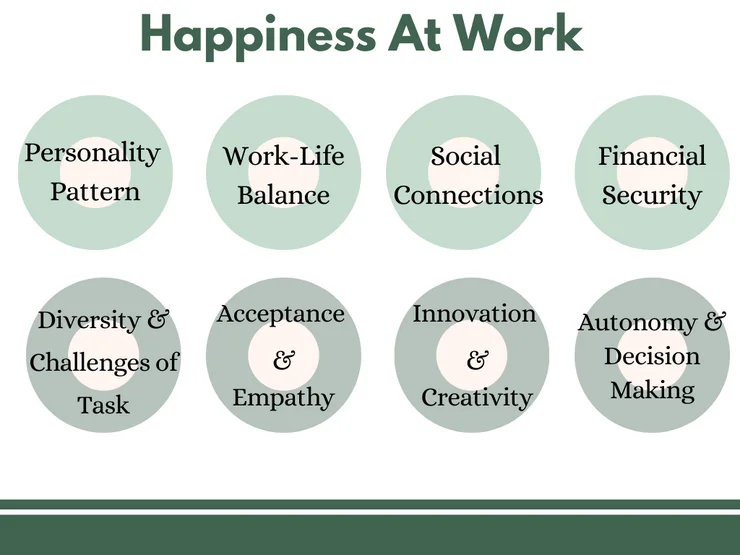
These are some of the frequent questions of discussion between the employees. It is important to be happy at work because happiness is directly linked to other aspects like productivity, effective leadership, communication among team members, etc. By incorporating a respectful and inclusionary culture within the company's operations, employees feel important and appreciated. Happiness at work is when employees enjoy tasks that are given to them, they have a good feeling about the people they are working with, having the opportunity to improve current skills which include the ability to deal with any setbacks with a calm mind, the ability to interact peacefully with colleagues, coworkers, clients, and customers. It also includes a sense of understanding that work matters to oneself, company, and even beyond.
According to Shawn Achor (2011), author of "The Happiness Advantage," a firm with happy workers boosts sales by 37% and productivity by 31%, both of which contribute to an efficient work environment and improves the lifestyle for all those associated with the job. He also adds that when a person is confident and happy, they may completely utilize their intellectual abilities. Creative ideas flow freely in a joyful state of mind, and people are better at problem-solving and making decisions.
Happiness and Productivity have a conclusive relationship as it includes enjoying what you do and embracing your workplace. Happy employees are motivated to work because they believe in the organization's aims which lead to increased engagement and higher productivity. They are better aware of the company's procedures in meeting client demands and resilient enough to stay with their company in the long run. Individuals who are happier at work are perceived as pleasant, dependable, and productive. They are more helpful to one another and compassionate to one another through tough times. All of these variables combine to boost productivity and profitability for the organization.
Research conducted by Oxford University's Said Business School at a British telecom business revealed that cheerful employees were 13% more productive. Caleb Papineau (2017), and author of the blog Tinypulse, has beautifully illustrated a model of how workplace happiness is related to and is improved by productivity and creativity. His statistical analysis revealed:
- Happy people are 31% more productive and three times more creative than others
- Happiness improves business profitability by 147%
Happiness at the workplace can begin by encouraging everyone to participate in learning new skills and development opportunities which adds to individual growth. Contributions by employees must be acknowledged by the administration. It does not have to be in the form of benefits or bonuses, it can simply be by acknowledging them for their efforts. Happiness at the workplace can be practiced by following some of the techniques given below-
- Engaging in Feedback Mechanisms- Workplace happiness and job satisfaction are linked by decisive and fast feedback. Employers or supervisors that provide frequent feedback and appreciate efforts are more likely to have a happy workforce.
- Helping Colleagues- Helping others brings us a degree of enjoyment and provides a sense of authority. Simple acts of kindness, statements of appreciation, and assisting coworkers in times of need may improve our self-esteem and make us happy at work.
- Recognizing and Acknowledging Work- Appraisal acts as a driving force for every individual to work harder. For Example – As an organization, an email can be sent out to the employee when you notice someone going above and beyond, or give it a personal touch by writing them a handwritten note. The unexpectedness of the gesture will give it a greater impact.
- Increasing engagement between employees- A lot of changes can be done by incorporating some lightness, inventiveness, and playfulness in the work environment. As an example, Employees at Southwest Airlines are encouraged to incorporate comedy and zeal into regular flight announcements, earning the business a reputation for valuing pleasure.
- Healthy Work-Life Balance- It's not only about being punctual at work to have a well-balanced work-life. In a larger sense, it's about putting things in order of their priorities. Prioritizing tasks allows an individual to save both time and energy. As a result, they can strike the ideal balance between job and personal life which ultimately leads to happiness
An atmosphere that encourages enjoyment, appreciation, feedback, recognition, satisfying work, rewards, trust, and incentivizes wellness for personal and professional growth can help to build happiness and productivity at the workplace.
Ready to build a better workplace?
Book a consultation with our expert team to design custom L&D programs, leadership bootcamps, and people solutions.
 RESEARCH